Design Leadership
How I work, and what I think the job actually is.
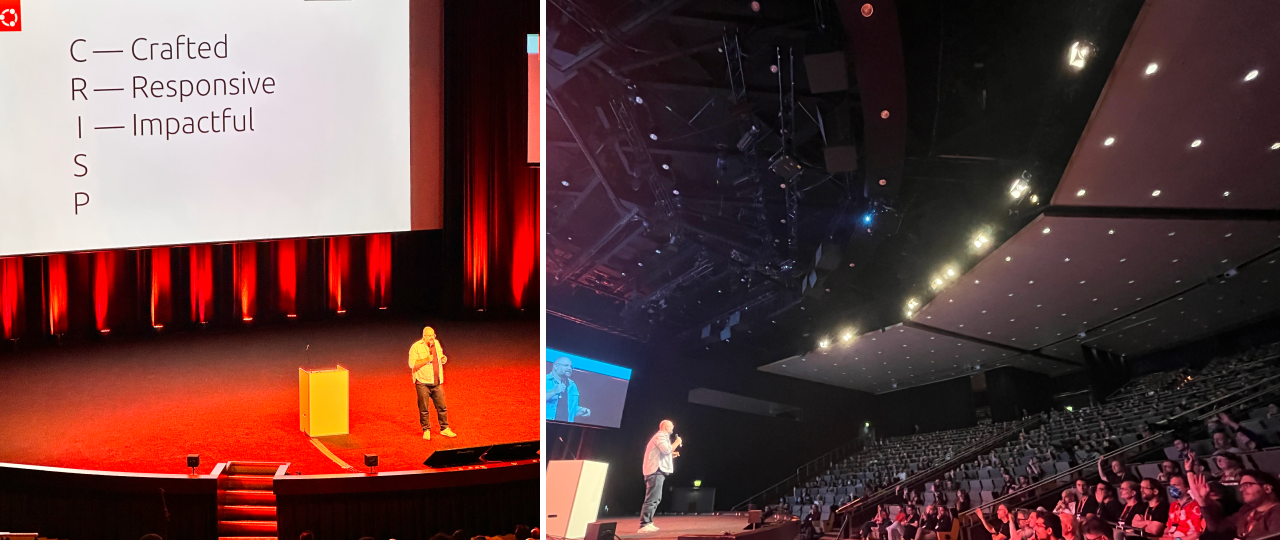
Internal company presentation Oct 2025, Gothenburg
The job of a design leader is to build the conditions under which great outcomes happen reliably, and keep happening when you are not in the room. This looks very different depending on the organisation, but the mechanisms stay constant. Standards, systems, people, and earned credibility. Most of what follows is a consequence of taking that seriously.
"There is no one size fits all for design leadership. The job is to build the conditions under which great outcomes happen reliably, and keep happening when you are not in the room."
Standards make quality repeatable
Taste, approach or process that lives only in one person's head doesn't scale, and it does not survive one person's calendar. This might work in early phase startups but even then the cost of coordinating those standards quickly comes under stress.
So I turn vision and judgement into frameworks the team can use autonomously. In practice that has meant different approaches over the years: shared language for critique and vision (CRISP/pillars); levelling frameworks that makes growth visible and expected across multidisciplinary teams; and rubric-based evaluations that hold essential parts of design process to a consistent bar (ticket quality/design reviews/plus ones).
Frameworks are how a standard outlives the meeting it was set in, and how (particularly distributed) teams stay coherent without a bottleneck in the middle.
Scale design through people
Hiring is the highest-leverage design decision you make. The composition of the team (the mix of individual traits and skillsets) sets the ceiling on everything else. No framework rescues a bad hire, and one great hire raises the bar for everyone near them.
So I treat hiring as a system, with a carefully calibrated panel, consistent signals across interviewers, and an experienced read on whether a candidate will raise that bar. Protecting that bar is a leadership KPI in its own right and I push back on the pressure to just fill seats. I'd rather carry a role open than lower the team as a whole.
Hiring sets the ceiling but investing in the team is how you reach it. I put real time into coaching, critique, and stretch work, and I make progression visible so growth is an understood evolution rather than time in seat. The designers I develop become the ones who raise the next cohort, and the strongest of them grow into leads.
I never stopped being a designer but what I design has changed. Now I design the team: its shape; the standards it holds; the way decisions are made; and the outcomes it seeks. My work is designing the vision and growing the managers and leads. Scaling design only works when you give the people who set the bar the capability and accountability for their own judgment rather than substituting my own.
Leadership isn't a one-trick pony
Design leadership that ignores the business is just taste with a budget. I've had the fortune over the years to lead in a number of environments: startups; enterprise; public vs private sector; expanding and tightening markets; and a number of different domains and business strategies. Each of these requires a different design leadership focus. A high-growth company needs speed and a coherent system before it needs perfection. A business moving through acquisition needs design that can absorb multiple ways of working, multiple design systems and multiple tech stacks without losing the user. A deeply technical product needs rigour, auditability, and respect for the power its expert users depend on, alongside a clear path in for the people arriving after them. The constant thing is the application of method and the variable is reading the business correctly and spending the focus where it counts.
Stay close enough to the craft to keep it honest
A leader who drifts away from the craft ends up defending standards they can no longer feel. Distance is one way to lose that feel and a narrow path is another. A leader who only ever came up through one discipline, say design systems, can hold that corner to a high bar but can't really feel the tradeoffs in research, or product thinking, or interaction craft. I have worked across those crafts, and it is what lets me weigh one against another rather than over-index on the one I know best. So I also stay hands-on in a systematic way rather than an ad hoc one. I run a weekly craft series with my team aimed at growth in communication, critique, estimation, the designer's role in an AI-shaped process, and the move from observation to strategy. I also sit in on critique panels, and I teach UX at master's level. All help keep me calibrated. Credibility earned this way is also what makes design a genuine partner to product and engineering rather than a service to them. In the rooms where strategy actually gets set, authority goes to the people who know what they are doing, not to the title on the door. The design I lead earns that seat by being consistently right about users and rigorous about craft and outcomes, not by demanding it.
In short
Design leadership is a system you build and a credibility you earn, not a position you are granted. None of this is theoretical for me. It is how I have operated through over a decade of leadership.
Back